The Tunguska Event: The Blast That Flattened a Forest
In 1908 an explosion over Siberia knocked down millions of trees across 830 square miles. No crater was ever found.
At about 7:15 a.m. on 30 June 1908, a huge explosion shook a remote part of Siberia. Evenki reindeer herders witnessed it. People nearest the blast were knocked down, some unconscious, and instruments hundreds of miles away recorded the shock wave.
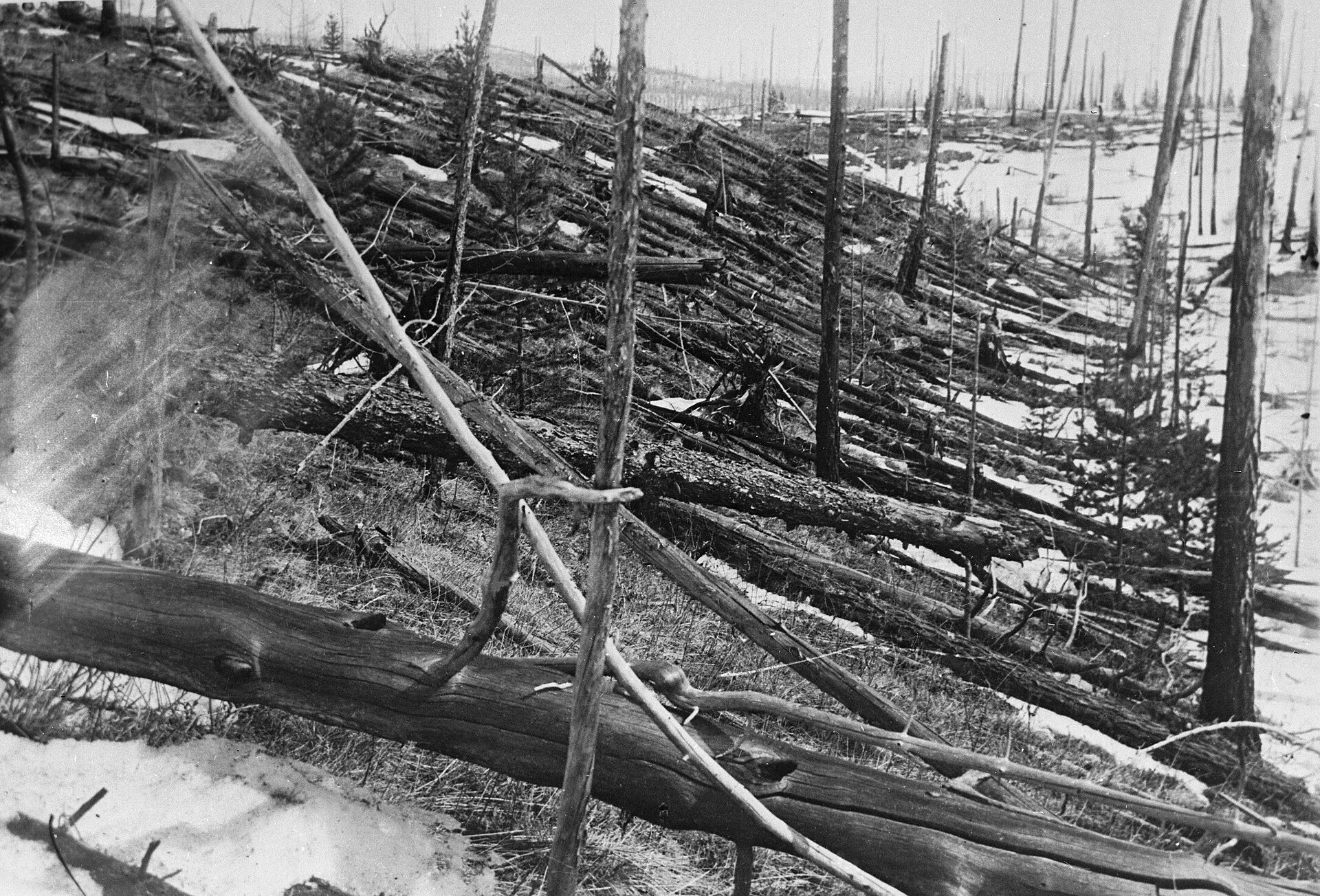
Millions of trees were knocked over across a butterfly-shaped area of about 830 square miles.
The site was so remote that the geologist Leonid Kulik only reached it in 1927. He found trees still standing near the centre, stripped of branches and bark, but no crater and no trace of the object.
NASA's explanation is an airburst: an asteroid, perhaps about 130 feet across, entered the atmosphere and exploded several miles up, vaporising before it reached the ground.
Evidence
- Witness accounts, seismic records and the pattern of fallen trees all point to an explosion in the air.
- Trees near the centre were left standing but stripped, as expected beneath a blast from above.
- No crater has been found. Tiny particles possibly from space were collected, but could not be tied to the blast for certain.
What do you think happened?
You have the evidence. Stamp your verdict before you read ours.
Verdict
MOSTLY EXPLAINEDA well-supported explanation exists; some details remain open.
An airburst is the accepted explanation. Because no piece of the object has been recovered, its exact size and makeup are still estimates.
How readers voted
Theories vs evidence
An asteroid or comet exploded in the air
SUPPORTEDFits the flattened forest, the standing trees at the centre and the missing crater.
A crashed alien spacecraft
UNPROVENNo wreckage or physical evidence of any craft has ever been found.
Sources
Image credits
- Tunguska Ereignis-1.jpg. Leonid Kulik, the expedition to the Tunguska event, Public domain
Published 2026-10-25. Spotted an error? Email provenmysteries@gmail.com.